
Home routines usually stall after 40 for one plain reason: people training on their own tend to lift lighter than they could, and the routine has no built-in way to get heavier. Your dumbbells are not the problem. Your loading is. That is worth saying carefully, because home training deserves real credit. If you work out in your basement or living room, you are already doing the hardest part, and research on home programs shows they can work. The evidence also shows where training alone tends to flatten out and what a coach watching your sets actually changes. Here is an honest look at both, and how to split the work between home and a coached room.
What does home training get right?
More than it usually gets credit for. Training at home removes the commute, the class schedule, and the self-consciousness some people feel walking into a gym. For adults 40 and over juggling work, family, and a full calendar, that convenience is often the difference between training and not training. The pandemic years turned a lot of living rooms into gyms.
The research supports home training, too. A 2024 review of home video exercise programs in Telemedicine and e-Health, covering 26 studies and 1,292 adults 65 and over, found weighted retention of 91.1% and attendance of 85.0%. A 2022 review in Age and Ageing found that digital home-based exercise improved lower-extremity strength, functional capacity, fall outcomes, and health-related quality of life in older adults. In studies, structured home programs worked.
So the question is not whether home workouts work. It is why a routine that worked well at first can feel stuck a year later.
Are your dumbbells the problem?
Usually not. The weight you pick up matters more than the weight you own. A 2022 meta-analysis in Sports Medicine pooled 18 studies and 359 people who were left to choose their own weights. On average, they selected loads of 53% of their one-rep max, the most they could lift a single time (the 95% credible interval ran from 49% to 58%). The authors put it carefully: loads like that "may be too light for optimal strength development."
At home, every set is a self-selected set. Nobody says "that looked easy, go up," and a set that feels hard is not always a heavy set. A burning muscle and a racing heart are real effort, but they are a different signal from a weight that makes the last two reps a genuine challenge with good form. Add a sensible caution about old injuries, and the weight tends to stay where it feels safe.
That is good news. Many home lifters probably have room left in the equipment they already own, and a coach can usually spot it quickly by watching how the reps move.
Why does a home routine stop progressing?
Loading is the first reason. Three others tend to build over months:
- A ceiling at the heaviest weight you own. A few pairs of dumbbells and a kettlebell cover a lot of ground, but the lower body usually outgrows them first. Once the heaviest option feels easy for squats and hinges, the choices at home narrow to more reps, slower reps, or more equipment. Adding reps indefinitely is not the same as having a plan.
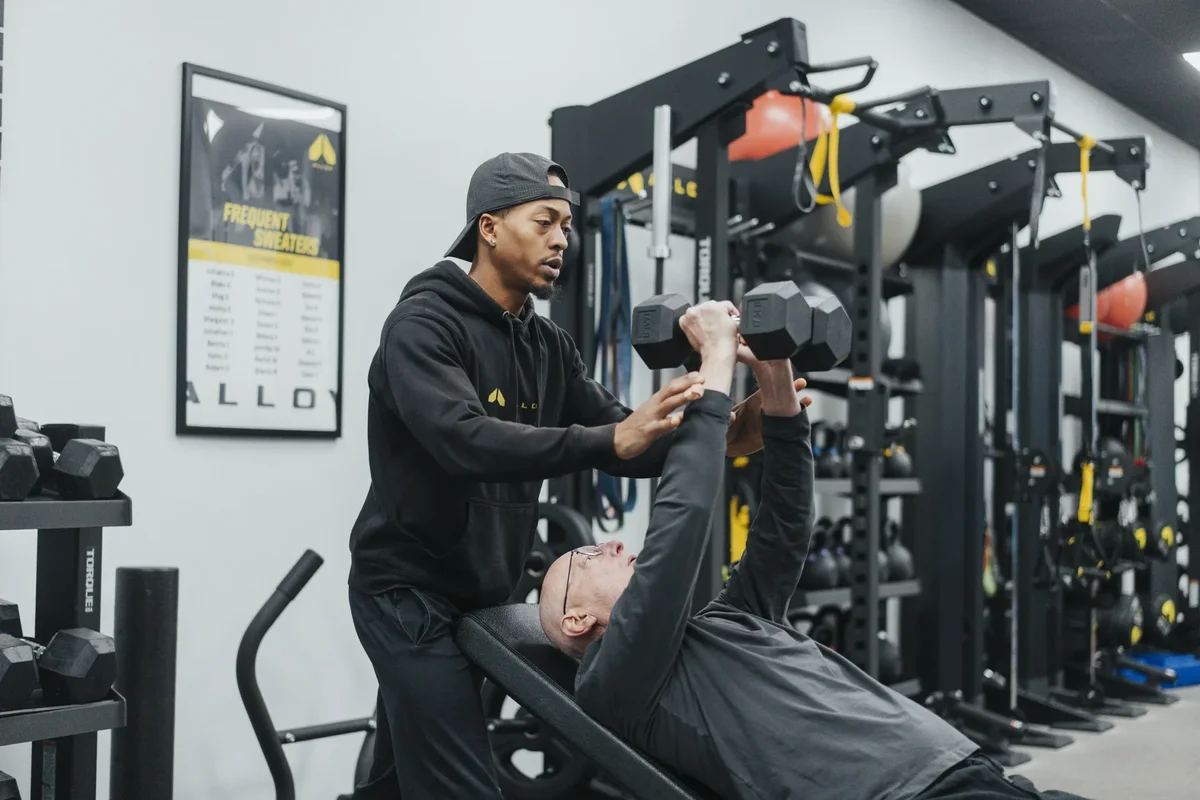
- No one watching the rep. You cannot see your own lower back during a hinge. A phone propped against the couch shows the problem after the set, not during it. Form tends to slip when a set gets hard, which is exactly when an outside eye is most useful.
- Drift. Routines erode quietly: a skipped week, a shorter session, the same workout you did last spring. The at-home boom has leveled off, too. In a 2023 connected-fitness forecast, eMarketer put US users at a peak of roughly 41.2 million, forecast 40.3 million for 2023 (down 2.3%), and projected 38.9 million by 2027. The forecast does not say why.
Drift is not a character flaw. What home routines usually lack is the structure around the workout: someone who expects you, tracks what you lifted, and decides what comes next.
What does supervision actually change?
Mostly strength, and the evidence points the same direction even where the effect is modest. A 2022 meta-analysis in the International Journal of Strength and Conditioning pooled 12 studies, with 301 supervised and 276 unsupervised participants, and found supervised resistance training produced greater strength gains, a standardized mean difference of 0.40. The same analysis found only a trivial difference in body composition (0.07).
The pattern shows up in experienced lifters and in adults 60 and over. In a 2023 randomized trial in the Journal of Sports Sciences, 36 trained adults spent eight weeks in supervised or unsupervised groups. The supervised group gained more muscle thickness in the triceps and two of the quadriceps muscles, and lower-body strength leaned toward supervision as well (a borderline result, p = 0.05). A 2024 meta-analysis in Sports Medicine of adults 60 and over, covering 34 studies and 2,830 people, found supervised exercise beat unsupervised for knee-extension strength, a standardized mean difference of 0.18 (p = 0.002).
The 2024 Sports Medicine analysis also undercuts a common assumption, that people exercising without supervision simply stop showing up. Weighted attendance was 81% in both the supervised and unsupervised groups. One caveat: trial participants get regular contact and check-ins that most people training on their own never have. Still, with attendance equal, the strength edge was not explained by who showed up more. It likely came from what happened during the sessions. A 2024 meta-analysis in BMC Geriatrics points the same way, finding unsupervised home exercise had little impact on lower-extremity function, though its studies were small and varied widely.
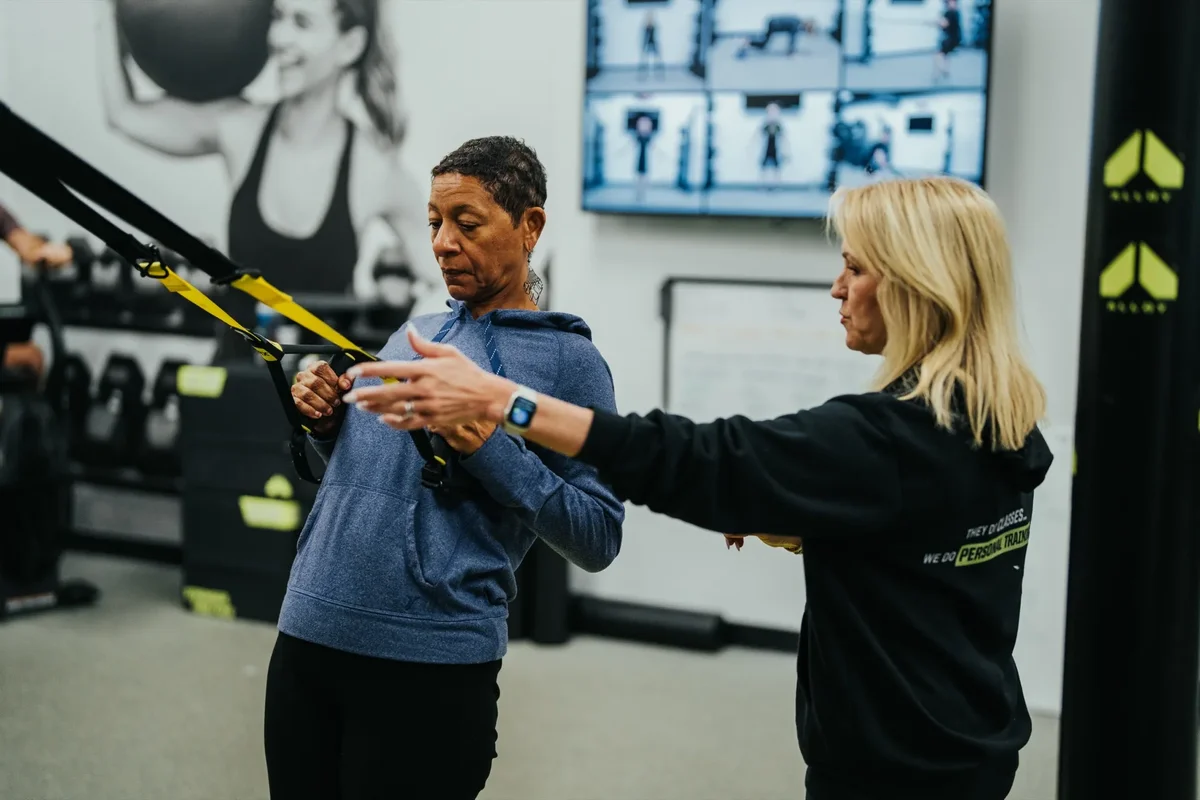
What happens during a coached session is not magic. It is feedback in real time: a coach who raises the load when the last rep looked easy, catches a knee drifting in on a split squat, and decides when you are ready for the next step. At Alloy Personal Training Middleton, sessions are capped at six members and run about 50 minutes, coach-led start to finish. Every exercise is progressed or modified for the person doing it, and progress is tracked so each step up is planned rather than guessed. Here is more on how small group training is individualized.
Key Takeaway
Home training works, and if you do it, you are already doing the hardest part. Where it tends to stall after 40 is loading: in research, people choosing their own weights averaged 53% of their one-rep max, and a home routine runs short of heavier options, outside eyes, and a plan for the next step. Supervised training shows a strength edge across studies, even in a review where attendance was equal. Keep the walks, mobility, and short home sessions. Put the strength work where a coach can see it.
What should you keep doing at home?
Most of it. Coaching is the progression layer, not a replacement for daily movement. The home video review cited earlier, the one with 85.0% attendance, also found that sessions over 60 minutes cut attendance by 24.39 percentage points. Shorter sessions tend to get done, and home is the natural place for short, regular ones.
A sensible split for most people:
- Keep the walks. A loop on the Pheasant Branch trail or a stretch along Lake Mendota does not need a coach.
- Keep the mobility work. Ten minutes on the floor after a long day at a desk is time well spent.
- Keep short home sessions for the things you already do well: bodyweight work, carries, and a few sets with your own dumbbells on days you are not in the studio.
- Move the heavy strength work into a coached room two or three times a week, where someone can see the rep, set the load, and plan the next step.
Home covers frequency and convenience. The coached session covers loading, form, and progression, the three things that are hardest to supply for yourself.
How do you start?
Keep what is working at home, and give the strength work a coach. Get Your Complimentary VIP Session at our studio at 8333 Greenway Blvd, Suite 140, just off the Beltline on Middleton's west side. The session includes a strength and mobility assessment, a goal-setting conversation, a customized fitness plan, a small group training preview, and an InBody scan, which measures muscle mass, body fat percentage, and water balance. There is no pressure and no obligation. Bring your home routine to the conversation, and your coach can show you where the loading has room to grow.
Most members notice improvements in energy, strength, and confidence within the first few weeks, and the monthly InBody scan helps make longer-term progress visible. If you are still weighing it, start with whether small group personal training is worth it, and our small group personal training page explains how sessions run.