
Structured progression beats random workouts after 40 for a plain reason: your body keeps getting stronger only when the work keeps getting a little harder, in planned steps, and random workouts rarely make it harder on purpose. Left to choose for themselves, people tend to pick lighter loads than strength research suggests they need. A 2022 review in Sports Medicine found that self-selected loads averaged 53% of one-rep max (the most you can lift once), largely regardless of age, sex, or experience. That is how you end up holding the same pair of dumbbells a year later, wondering why nothing has changed.
What is progressive overload, in plain words?
It means gradually asking your muscles to do a little more than they are used to, so they have a reason to adapt. "More" can be a heavier weight, another rep or two, an extra set, a slower lowering phase, or a harder version of the same movement. The demand rises on purpose, in steps small enough to recover from and large enough to matter.
The idea sits at the center of mainstream exercise guidance. The 2009 position stand on progression in resistance training from the American College of Sports Medicine (ACSM) puts it directly: "In order to stimulate further adaptation toward specific training goals, progressive resistance training (RT) protocols are necessary." If the work never gets harder, your body has no reason to keep changing.
Why does the same workout stop working?
Because your body gets used to it. Strength researchers call this accommodation, which Zatsiorsky and Kraemer's textbook, Science and Practice of Strength Training, defines as the decreased response of a biological system to a constant stimulus. A new routine is a new demand, so the early weeks often bring real progress. Repeat the same routine long enough and it stops being a challenge and becomes maintenance.
That is the quiet trap of a routine you like. The same three sets of ten with the same dumbbells, the same circuit every Tuesday, the same class you have taken for two years: each one felt hard once. The fix is a plan where the demand keeps rising in steps, which is harder to run on your own than it sounds.
Why do people lift too light on their own?
Because comfortable feels like enough. Steele and colleagues' 2022 review in Sports Medicine pooled 18 studies with 359 participants to answer a blunt question: are trainees lifting heavy enough? Often, not quite. Self-selected loads averaged 53% of one-rep max, with a 95% credible interval of 49–58%, and the pattern held largely regardless of age, sex, or training experience. The authors concluded those loads "may be insufficient" for optimal strength development.
An earlier study points the same way. In Glass and Stanton's 2004 paper in the Journal of Strength and Conditioning Research, novices told to choose loads "sufficient to improve your muscular strength" picked only 42–57% of their one-rep max. That is below the 60% or more typically associated with strength adaptation. These were people explicitly trying to get stronger, and they still landed short.
None of this is a character flaw. After 40, a sore back or a cranky shoulder makes caution the sensible default. The trouble is that caution without a plan quietly becomes the same weight forever. A coach who has watched your form, knows your history, and saw that your last two reps were clean is in a far better position to say "go up" than you are in the middle of a set.
Does a structured program really beat random workouts?
The research suggests a moderate advantage, and it is larger for people who are new to lifting. A 2017 meta-analysis in Sports Medicine by Williams and colleagues compared periodized training, where load and volume change on a planned schedule, with non-periodized training. Across 81 effects from 18 studies, periodized programs improved one-rep max strength more (effect size 0.43, 95% CI 0.27–0.58), and the difference was larger in untrained participants. The authors wrote that "variation in training stimuli appears to be vital for increasing maximal strength."
Keep it in proportion: an effect size of 0.43 means a plan tends to help, not that it doubles anyone's results. And "untrained" describes many adults who start strength training after 40, which makes the finding more relevant here.
The variation that matters is planned: loads and volumes that change on purpose, toward a goal. A class that is different every day feels varied, but often nothing in it is built deliberately from one week to the next. Random and periodized can both leave you tired. Only one of them is designed to leave you stronger.
What does sensible progression look like after 40?
Small, planned steps, with recovery treated as part of the program. The same 2009 ACSM stand gives a concrete rule: when you can perform the current workload for 1–2 reps over your target, increase the load by 2–10%. For novices, it recommends training at an 8–12 RM, meaning a weight you can lift at most 8 to 12 times. ACSM has since published a successor, its April 2026 position stand on resistance training prescription for healthy adults, drawing on 137+ studies and 30,000+ participants.
In practice, it looks unglamorous. Say your target is three sets of ten. Once you are getting 11 or 12 clean reps, the weight goes up a small step and you work back toward ten. Some weeks the step is a heavier dumbbell, some weeks a slower tempo or a harder variation, and some weeks, when sleep or work has been rough, it is holding steady.
A 2019 position statement from the National Strength and Conditioning Association (NSCA) on resistance training for older adults points the same way. It calls for "individualization, periodization, and progression" and describes programs working toward 2–3 sets of 1–2 multijoint exercises per major muscle group at 70–85% of one-rep max, 2–3 times per week. Its targets are set for that group, so treat them as the direction guidance moves as you get older, not a prescription for a 45-year-old. It also finds no added benefit from training to failure in that group. Not every set has to end in a grind.
Progression keeps paying off past 50, too. Meta-analyses by Peterson and colleagues of adults 50 and over found strength increased about 25–30% and lean mass rose about 1.1 kg after 18–20 weeks of progressive resistance training, as summarized in a EurekAlert news release. Those were supervised research programs, so the figures describe study results, not what any one person will gain.
Key Takeaway
Progressive overload means the work gets harder in planned steps, and it is what separates training that builds strength from training that repeats. Left alone, people choose loads averaging 53% of their max, which is how a routine becomes a year of the same dumbbells. Research suggests a moderate advantage for structured programs, especially for newer lifters, and the 2009 ACSM stand offers a simple rule: add 2–10% once you beat your target by 1–2 reps. A coach makes those calls, and a monthly InBody scan makes progress visible.
How does a coach turn progression into a system?
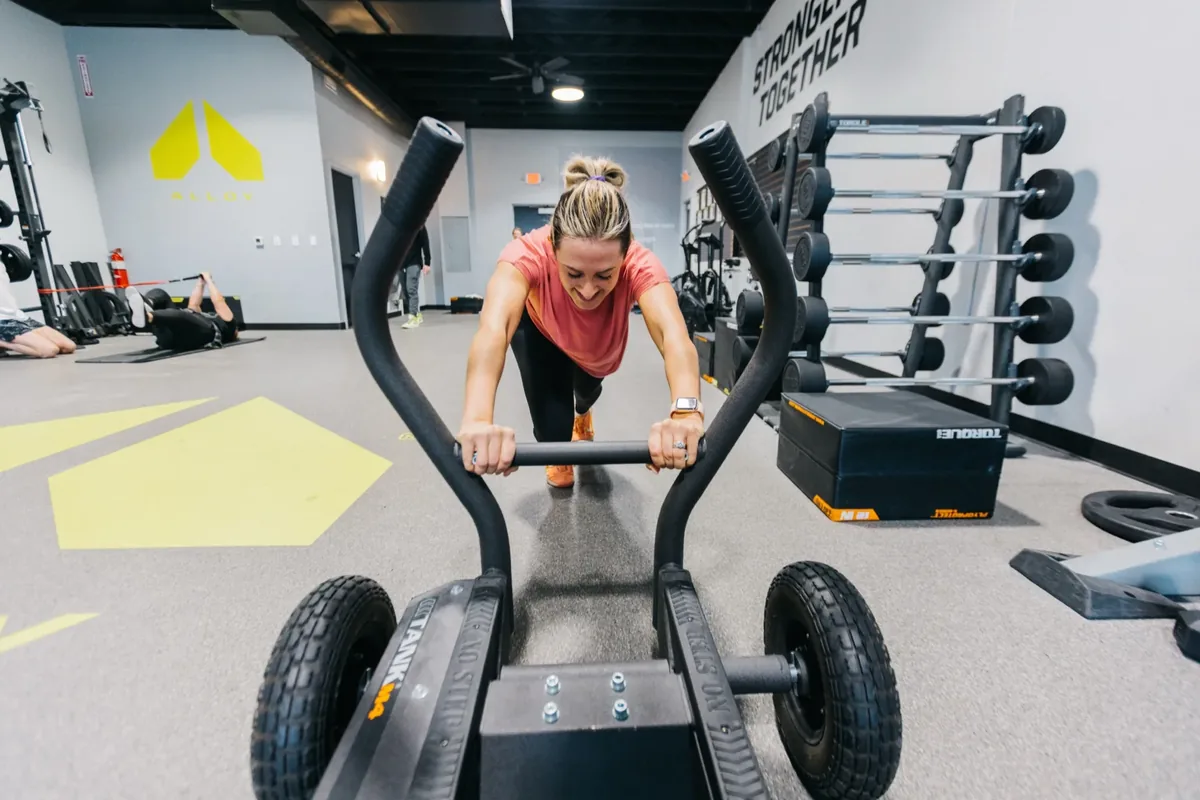
By making the decisions you would otherwise guess at. The NSCA's three words (individualization, periodization, and progression) describe what a coached small group is built to deliver. At Alloy Personal Training Middleton, every member starts with an assessment, so your coach knows where you are starting, how you move, and which joint needs a modified range before the first program is written. Sessions are capped at six members and run about 50 minutes, so your coach sees every rep.
Progression then runs on two timescales. Session to session, your coach adjusts the load, reps, or variation based on what the last set looked like: two clean reps over target means the weight goes up, a grinding rep means it holds. Block to block, the program changes on a planned schedule, so the demand keeps rising without you having to invent the next step. We wrote more about how one coach individualizes training for six different people.
Then there is the part that is hardest to get training alone: proof. Your first InBody body composition scan happens at your first session, and you scan again every month. It measures muscle mass, body fat percentage, and water balance, so progress becomes a tracked line instead of a feeling about how your jeans fit. Paired with retested strength numbers, it shows you and your coach what is working and what should change. Most members notice improvements in energy, strength, and confidence within the first few weeks; body composition change typically shows over 8–12 weeks, and long-term results come from consistency.
How do you start?
Let a coach set the starting line, then let the plan take it from there. Get Your Complimentary VIP Session at our studio at 8333 Greenway Blvd, Suite 140, just off the Beltline on Middleton's west side. It includes a strength and mobility assessment, an InBody scan, a goal-setting conversation, a customized fitness plan, and a small group training preview, with no pressure and no obligation. You will leave knowing where your progression starts. For the bigger picture, read how we approach strength training for adults over 40, or our honest take on how long you need a personal trainer.